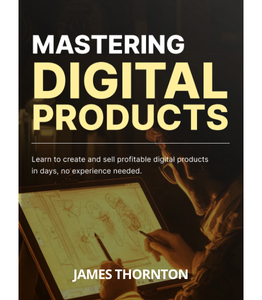
Mastering Digital Products
Why This Book Is Listed
Selected for providing comprehensive guidance on building digital product businesses from concept to sustainable income, emphasizing both upfront investment required and long-term passive revenue potential.
At a Glance
- Category: Marketing & Sales
- Type: Business development guide
- Approach: Strategic and systematic
- Reading Style: Practical with implementation steps
Short Description
A comprehensive guide to building scalable passive income through digital products covering niche identification, product development, sales funnel optimization, automation strategies, and long-term revenue sustainability.
What You'll Learn
- Identifying profitable niches through market research using Google Trends, social media analysis, and competitor evaluation
- Creating high-quality digital products across formats including ebooks, online courses, templates, and software
- Structuring engaging online courses with interactive materials, professional video production, and accessibility features
- Designing high-converting sales funnels with compelling lead magnets, landing pages, and automated email sequences
- Leveraging social media marketing, paid advertising, and content marketing for customer acquisition
- Scaling through product line diversification, strategic partnerships, customer retention, and market expansion
Who This Book Is For
This book is a good fit if you:
- Have expertise or knowledge to share but unsure how to package it into profitable digital products
- Seek location-independent income streams providing financial freedom and flexibility
- Want to build passive revenue alongside client work or existing employment
- Are an existing business owner looking to diversify revenue with digital offerings
- Understand that passive income requires significant upfront effort creating quality products
- Are willing to invest in learning sales funnels, email marketing, and automation systems
- Recognize that sustainability requires product updates, customer support, and continuous marketing
Full Description
Digital products offer powerful opportunities for passive income—products created once and sold repeatedly without inventory, shipping, or physical storage costs. The market has grown exponentially driven by global accessibility (reach customers worldwide instantly), minimal overhead costs (no manufacturing or warehousing), unlimited scalability (serve 10 or 10,000 customers with same infrastructure), and automated delivery systems handling fulfillment 24/7. Essential foundations include identifying profitable niches through market research using Google Trends revealing search volume trends, social media analysis discovering audience pain points and interests, and competitor evaluation identifying gaps in existing offerings. Developing unique value propositions differentiates your products through specific problem-solving approaches, expertise positioning, or format innovations resonating with target customers. Digital product formats span ebooks (comprehensive guides, workbooks, planners), online courses (video-based instruction, downloadable resources, quizzes), software and apps (productivity tools, plugins, SaaS), templates (design files, spreadsheets, checklists), and digital art (graphics, photography, music).
Creating high-quality online courses requires strategic structure with clear learning objectives, logical progression building on previous concepts, interactive materials maintaining engagement (worksheets, exercises, discussions), professional video recording using quality audio and lighting even with modest equipment, editing for pacing and clarity removing dead air and mistakes, and accessibility features like captions and transcripts serving diverse audiences including hearing impaired or non-native speakers. Quality separates successful courses generating positive reviews and referrals from mediocre offerings struggling with refunds and complaints. Sales systems drive revenue through carefully designed funnels: lead magnets (free valuable content) capturing email addresses, landing pages with compelling copy and clear value propositions converting visitors into leads, automated email sequences nurturing relationships and presenting offers strategically, and upsells or cross-sells maximizing customer lifetime value through complementary products.
Marketing and automation scale customer acquisition without proportional time investment. Social media marketing shares valuable content building authority and community, paid advertising on Facebook, Google, or YouTube targets specific demographics with tested offers, content marketing through blogs, podcasts, or YouTube channels provides SEO benefits and demonstrates expertise attracting organic traffic. Automation systems include CRM platforms managing customer relationships and tracking interactions, chatbots handling common questions instantly, help desk solutions organizing support tickets efficiently, and payment processors and course platforms (Teachable, Thinkific, Kajabi) delivering products automatically after purchase. This infrastructure enables truly passive income where sales happen without direct involvement once systems operate smoothly—though maintenance, updates, and marketing require ongoing attention preventing completely hands-off operations.
Scaling for long-term sustainability requires strategic growth beyond initial products. Product line diversification creates multiple income streams reducing dependence on single offerings—basic to advanced course progressions, complementary products serving same audience, or expansion into related niches. Strategic partnerships and collaborations with complementary businesses or influencers extend reach through affiliate programs, joint ventures, or co-created products. Customer retention through membership communities, exclusive updates, and personalized support generates recurring revenue more profitably than constant new customer acquisition. Market expansion explores international audiences through translations, different platforms reaching new demographics, or corporate training adaptations of consumer products. The emphasis remains on initial commitment creating quality products, building effective sales systems, and establishing automation—followed by long-term rewards of passive income, location independence, and scalability. Success requires maintaining product relevance through updates, staying ahead of market trends and technological innovations, building loyal customer communities providing feedback and referrals, and strategically outsourcing or automating operations focusing personal time on high-value activities like product development and strategy rather than repetitive tasks.